Patches, not regeneration
Truth tables
- An argument is valid if its premises are true.b12
- Valid means the conclusion follows from the premises.b9
- Start with the easiest column, usually a negation.b14
returned by the note model
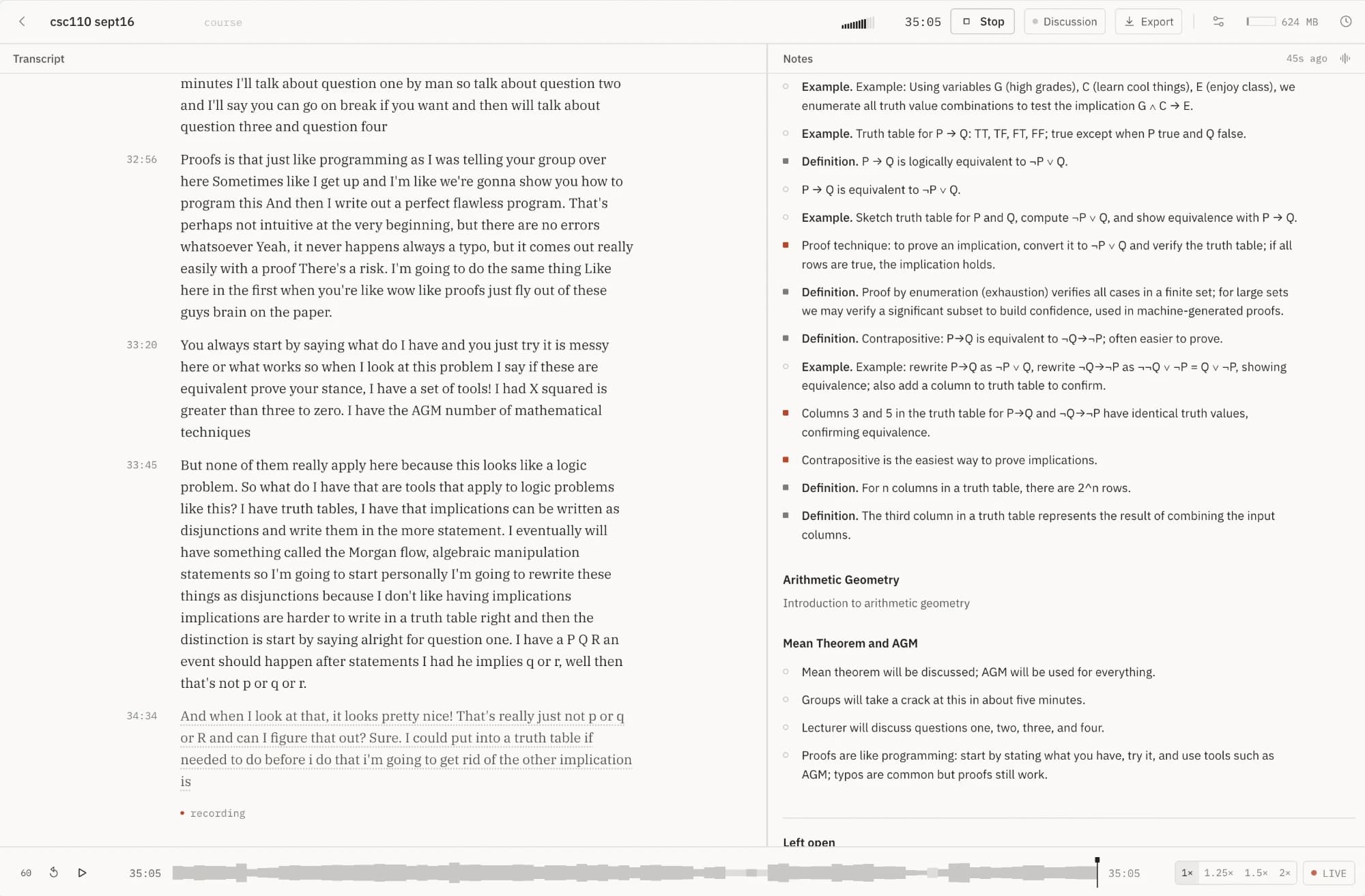
kewind records the lecture in your browser and writes the transcript and a set of structured notes beside it. Missed a sentence? Go back and hear it again while the recording carries on.
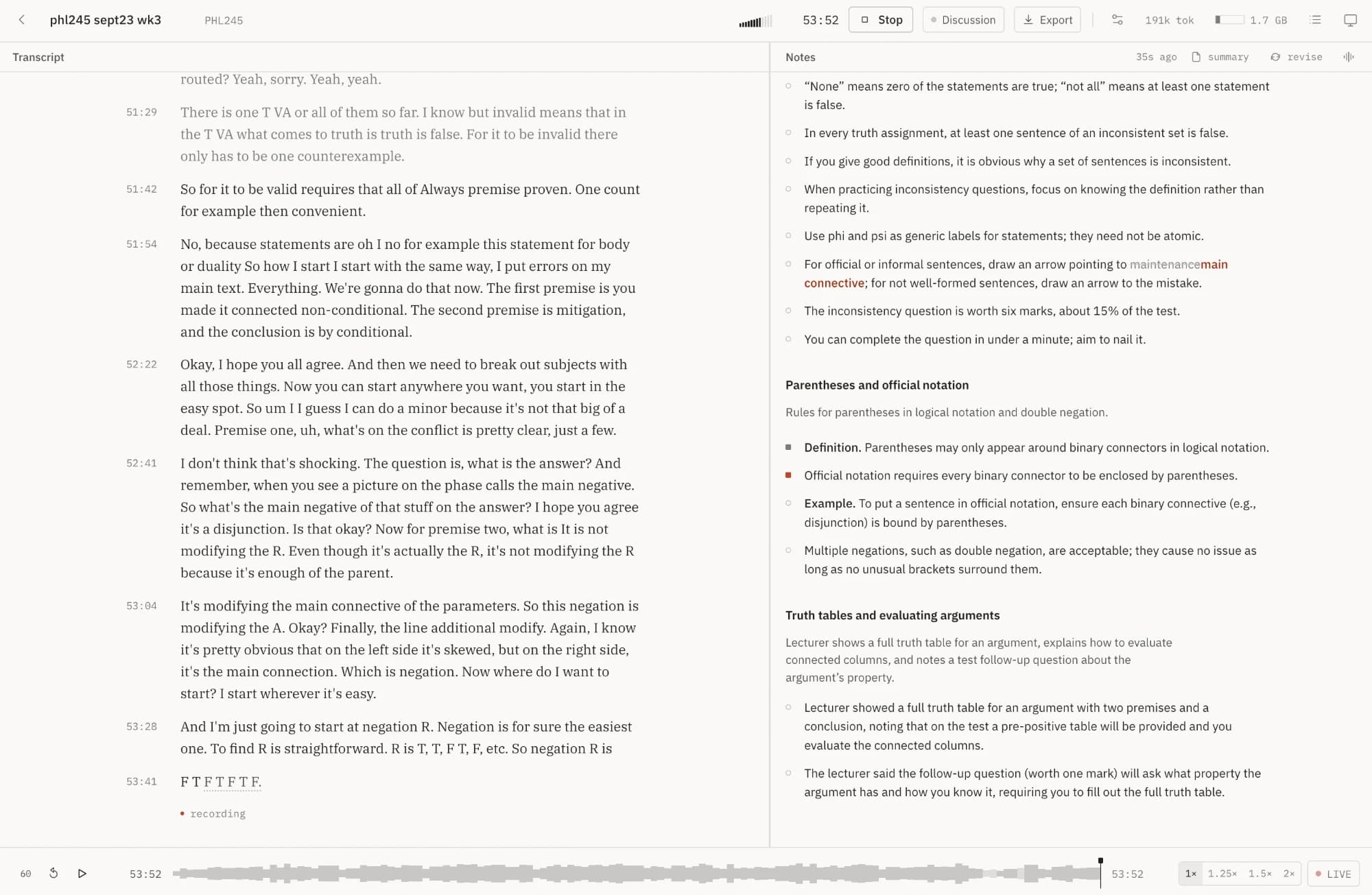
Invalid means there's a row where every premise is true and the conclusion is false. For it to be invalid there only has to be one counterexample.
So for it to be valid, every row where all the premises are true has to make the conclusion true. One counterexample is enough to sink it.
So how do I start? I start the same way. I put arrows on my main connectives. The first premise is a conditional, the second is a negation, and the conclusion is a biconditional.
Now you can start anywhere you want. Start in the easy spot. Premise one, what's the main connective? It's pretty clear. It's a disjunction.
Premise two. The negation is not modifying the R. Even though it's sitting right next to the R, it's modifying the whole parenthesis.
recording
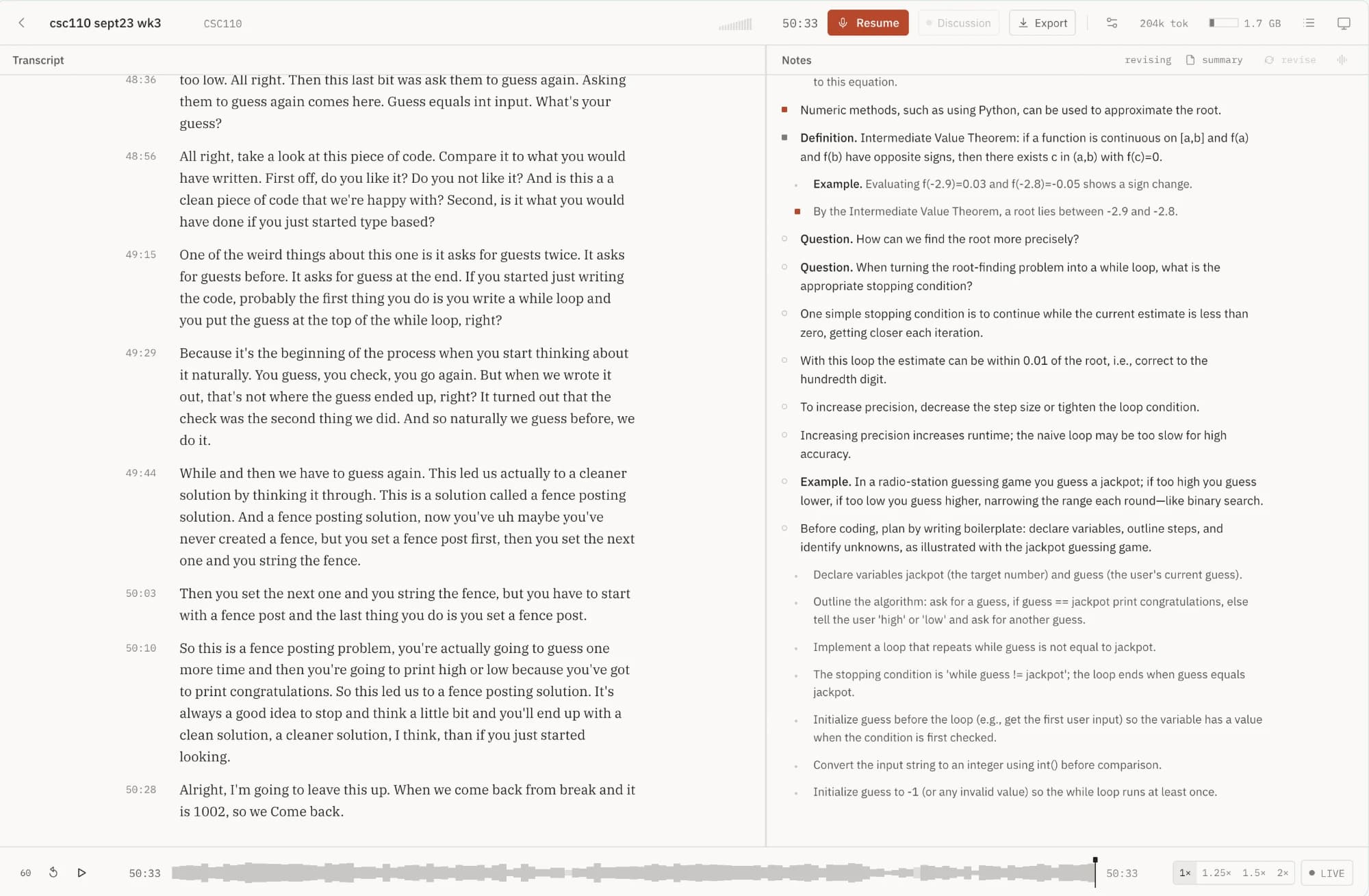
Live.Drag the timeline back, or click any timestamp.
First-year philosophy and computer science, recorded from a seat in the hall. Nothing here was cleaned up for the page.
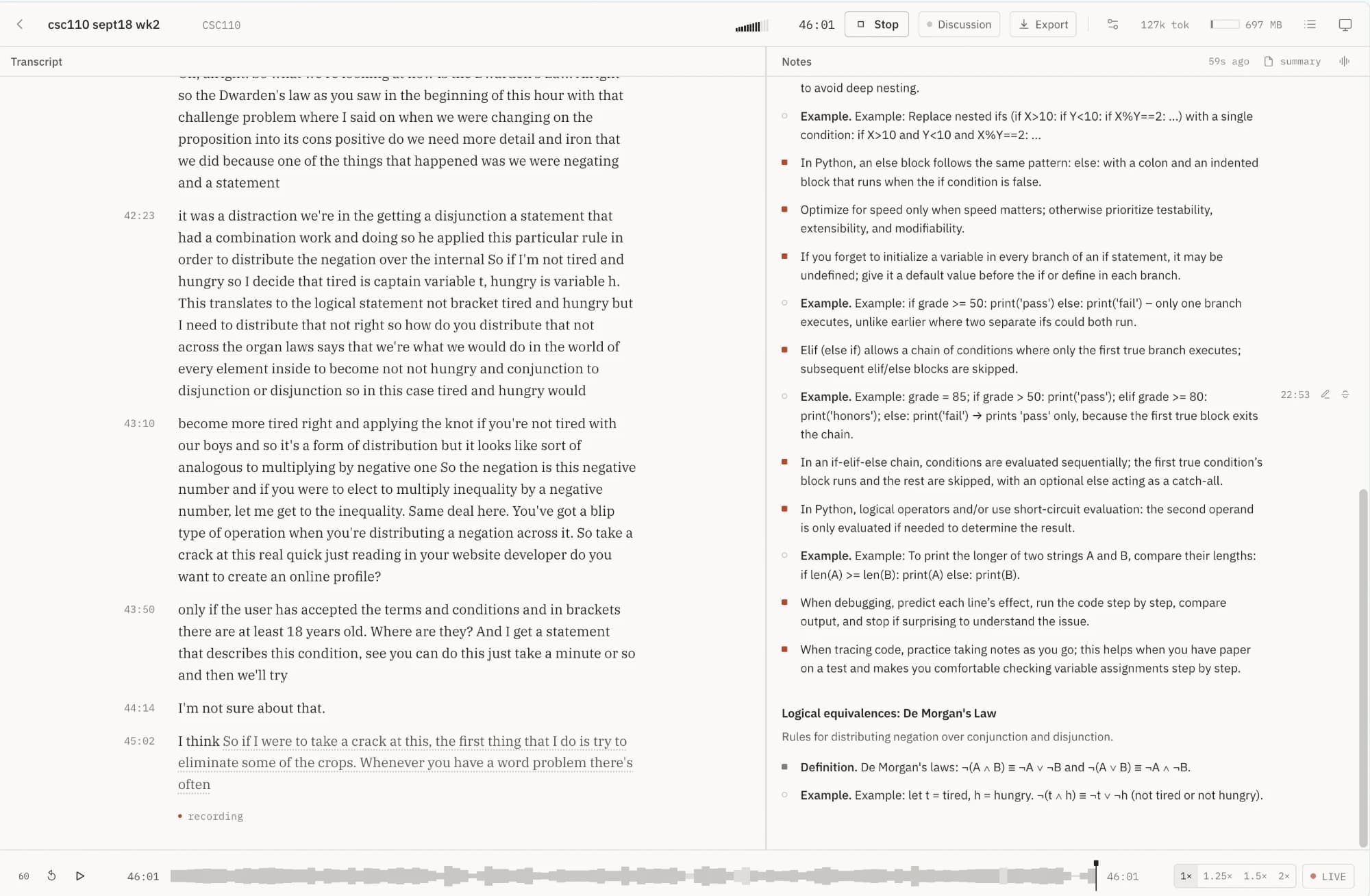
Summarise every minute of a lecture and append the results, and you get the same point written six times. kewind hands the model the notes as they stand and takes back a few edits, so the page gets better instead of longer.
Patches, not regeneration
Truth tables
returned by the note model
Discussion mode
…so that’s the definition. Try the next one with the people next to you.
Okay, let’s vote. Who said Q arrow P?
D Still recorded, still in the transcript, never shown to the note model.
Strike
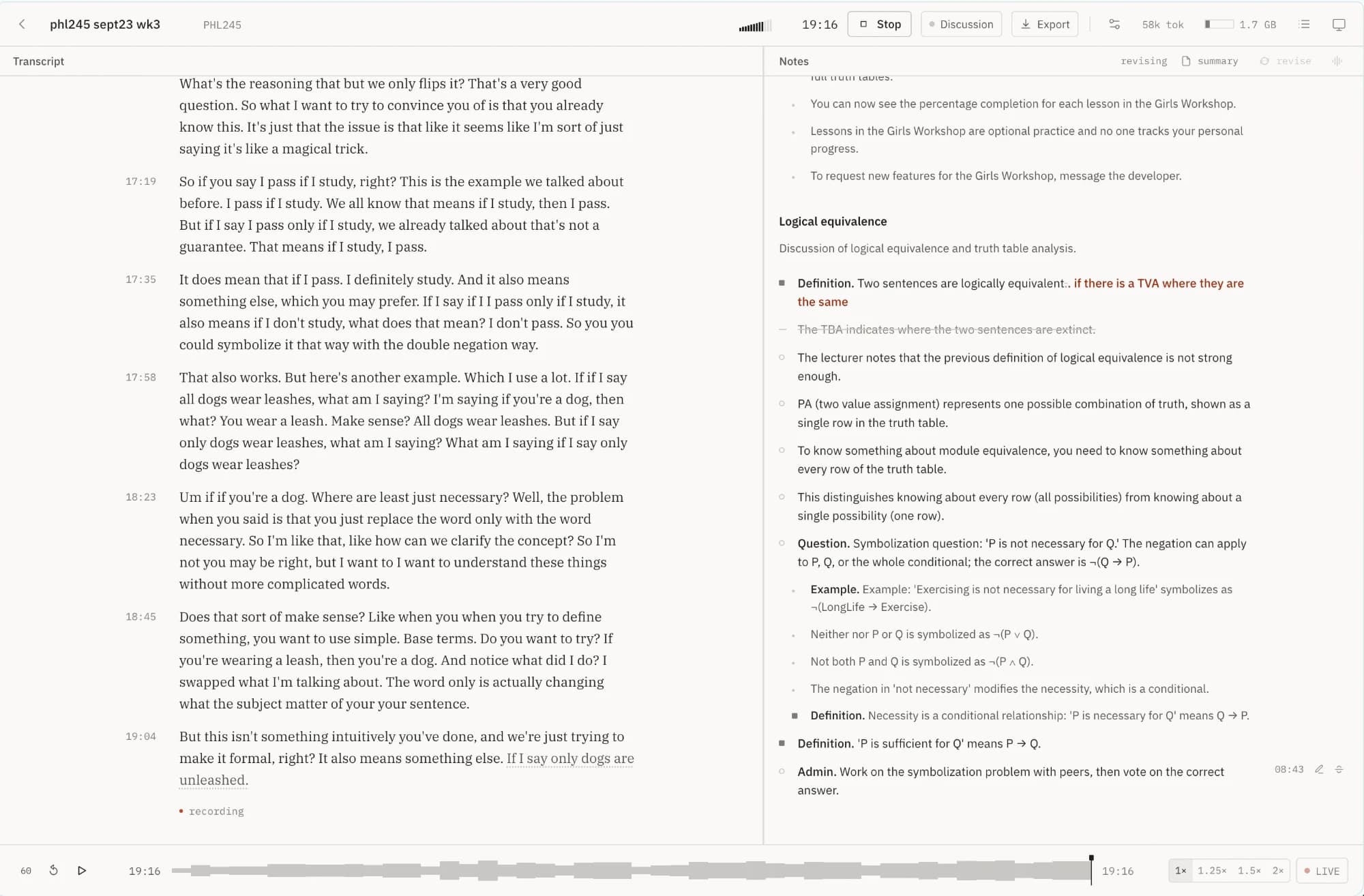
The TBA indicates where the two sentences are extinct.
Struck bullets stay visible and export struck. The model is told not to write them again.
Source links
Click the time and the audio starts 1.5 seconds early. A sentence needs its run-up.
Master summary
Symbolising English
| Phrase | Symbolises as |
|---|---|
| P only if Q | P → Q |
| P is necessary for Q | Q → P |
| Neither P nor Q | ¬(P ∨ Q) |
The one time the model sees the whole lecture: a rewrite into headings, prose and tables, written when you ask for it.
Out and around
Every stage saves its work before the next one starts. Close the lid mid-lecture and you lose one chunk at most. Record with no provider set up and the work waits in a queue until you add one.
Audio is cut into 24-second chunks, each a complete file, and written to your browser's storage as it's recorded.
Opus · 32 kbps · ~14 MB/hour
Chunks that are only room noise are never sent anywhere. Nothing to pay for, nothing for a model to hallucinate over.
rolling noise floor, not a fixed threshold
On your laptop or with a provider you pick. The newest line stays underlined until the next chunk confirms where the sentence ended.
Whisper · Parakeet · Groq · OpenAI · self-hosted
Every minute or so the note model reads what's new and sends back a few edits to the notes. Never a fresh copy.
Claude · any OpenAI-compatible model · Ollama
No accounts and no sign-in. Requests to a provider pass through kewind’s server, which forwards them and keeps nothing. Models see only what their one job needs, and only the models you picked see anything.
The catch: clearing your browser’s site data deletes your recordings. Export what you want to keep.
“I stopped trying to write everything down. I write the one thing I actually think, and kewind has the rest — including the forty seconds I spent confused.”
Placeholder tiers and prices. Nothing here is decided.
For anyone with a laptop and their own API key — or none.
Free
Hosted transcription and notes, no keys to manage.
$4/ month, billed yearly
Accessibility offices and course teams.
Custom
Open it before the lecturer starts, press record, and listen to the lecture instead of transcribing it by hand.